Questõesde PUC - Campinas 2016 sobre Inglês

1
1
1
Foram encontradas 10 questões
e87d4753-c2
PUC - Campinas 2016 - Inglês - Interpretação de texto | Reading comprehension

According to the text,

    Born on April 15, 1452, in Vinci, Italy, Leonardo da Vinci was the son of a prominent attorney notary and a young peasant girl. Born out of wedlock, he was raised by his father, Ser Piero, and several stepmothers.

    His early years were spent living on his father’s family estate in Vinci. Beyond basic reading, writing and mathematical skills, da Vinci did not receive much of a formal education. Recognizing his potential as an artist, his father sent him at the age of 14 or 15 to apprentice with sculptor and painter Andrea del Verrocchio of Florence.

    He spent six years honing his technical skills, including metalworking, leather arts, carpentry, drawing and sculpting, and became a member of the Guild of Saint Luke by the age of 20. He remained with Verrocchio until he became an independent master in 1478. Around that time, he took on his first commissioned work, The Adoration of the Magi, for Florence’s San Donato, a Scopeto monastery, but departed for Milan the following year, leaving the painting unfinished. It has been in the Uffizi Gallery in Florence since 1670.

    Leonardo was, and is, renowned primarily as a painter. Among his works, the Mona Lisa is the most famous and most parodied portrait and The Last Supper the most reproduced religious painting of all time, with their fame approached only by Michelangelo's The Creation of Adam. Leonardo's drawing of The Vitruvian Man, based on the correlations of ideal human proportions with geometry described by the ancient Roman architect Vitruvius, is also regarded as a cultural icon, being reproduced on items as varied as the euro coin, textbooks, and T-shirts.

    Leonardo is also revered for his technological ingenuity. In the early 1490s, he began chronicling his thoughts about painting, architecture, mechanics and human anatomy. These notebooks contained wide-ranging ideas, including plans for a “flying machine,” bicycle and drawings of a fetus in the womb and the human skeleton.

    His interests and intellect traversed so many disciplines that he symbolized the term “Renaissance Man”. Unfortunately, these notebooks were not published and his ideas did not advance scientific understanding in the Renaissance period.

    Today, Leonardo is widely recognized as one of the most diversely talented individuals ever to have lived.

                        (Adapted form: http://www.livescience.com/39355-leonardo-da-vinci.html) 


A
Leonardo first started painting when he was in primary school.
B
the “Renaissance Man” is known for being accomplished in both arts and science.
C
Leonardo’s annotations fostered scientific development in his days.
D
both the Creation of Man and the Mona Lisa are among the most parodied works of all time. 
E
although Leonardo tried his hand at sculpting, he never produced a sculpture.
e8791b48-c2
PUC - Campinas 2016 - Inglês - Interpretação de texto | Reading comprehension

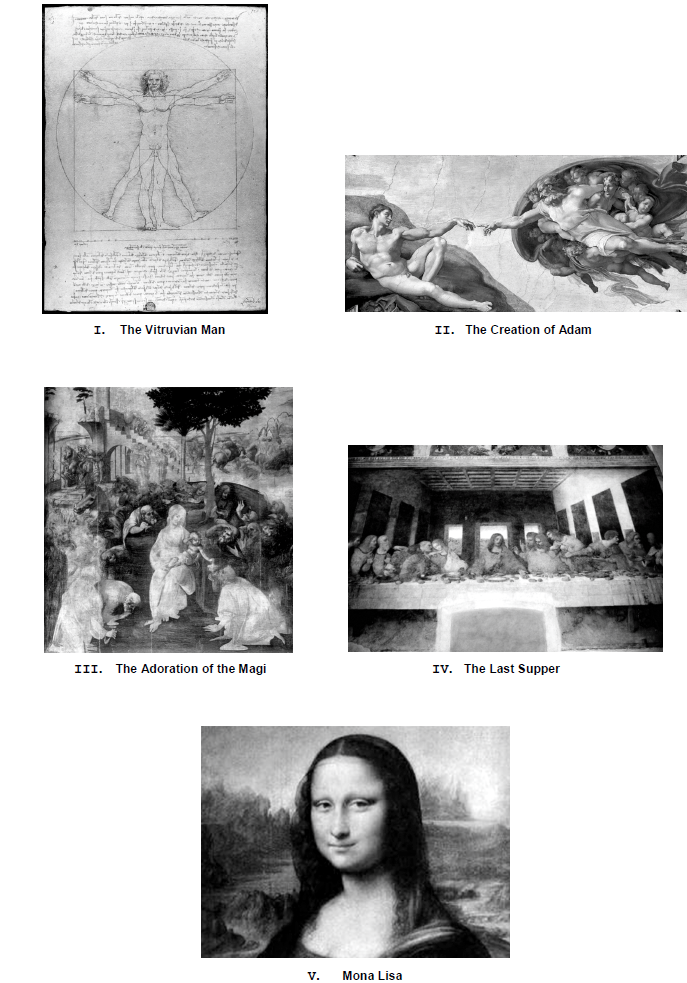
Which of the paintings below was NOT authored by Leonardo da Vinci?

    Born on April 15, 1452, in Vinci, Italy, Leonardo da Vinci was the son of a prominent attorney notary and a young peasant girl. Born out of wedlock, he was raised by his father, Ser Piero, and several stepmothers.

    His early years were spent living on his father’s family estate in Vinci. Beyond basic reading, writing and mathematical skills, da Vinci did not receive much of a formal education. Recognizing his potential as an artist, his father sent him at the age of 14 or 15 to apprentice with sculptor and painter Andrea del Verrocchio of Florence.

    He spent six years honing his technical skills, including metalworking, leather arts, carpentry, drawing and sculpting, and became a member of the Guild of Saint Luke by the age of 20. He remained with Verrocchio until he became an independent master in 1478. Around that time, he took on his first commissioned work, The Adoration of the Magi, for Florence’s San Donato, a Scopeto monastery, but departed for Milan the following year, leaving the painting unfinished. It has been in the Uffizi Gallery in Florence since 1670.

    Leonardo was, and is, renowned primarily as a painter. Among his works, the Mona Lisa is the most famous and most parodied portrait and The Last Supper the most reproduced religious painting of all time, with their fame approached only by Michelangelo's The Creation of Adam. Leonardo's drawing of The Vitruvian Man, based on the correlations of ideal human proportions with geometry described by the ancient Roman architect Vitruvius, is also regarded as a cultural icon, being reproduced on items as varied as the euro coin, textbooks, and T-shirts.

    Leonardo is also revered for his technological ingenuity. In the early 1490s, he began chronicling his thoughts about painting, architecture, mechanics and human anatomy. These notebooks contained wide-ranging ideas, including plans for a “flying machine,” bicycle and drawings of a fetus in the womb and the human skeleton.

    His interests and intellect traversed so many disciplines that he symbolized the term “Renaissance Man”. Unfortunately, these notebooks were not published and his ideas did not advance scientific understanding in the Renaissance period.

    Today, Leonardo is widely recognized as one of the most diversely talented individuals ever to have lived.

                        (Adapted form: http://www.livescience.com/39355-leonardo-da-vinci.html) 


A
IV.
B
I.
C
III.
D
II.
E
V.
e875b9fc-c2
PUC - Campinas 2016 - Inglês - Interpretação de texto | Reading comprehension

From the above text, one can infer that

    Born on April 15, 1452, in Vinci, Italy, Leonardo da Vinci was the son of a prominent attorney notary and a young peasant girl. Born out of wedlock, he was raised by his father, Ser Piero, and several stepmothers.

    His early years were spent living on his father’s family estate in Vinci. Beyond basic reading, writing and mathematical skills, da Vinci did not receive much of a formal education. Recognizing his potential as an artist, his father sent him at the age of 14 or 15 to apprentice with sculptor and painter Andrea del Verrocchio of Florence.

    He spent six years honing his technical skills, including metalworking, leather arts, carpentry, drawing and sculpting, and became a member of the Guild of Saint Luke by the age of 20. He remained with Verrocchio until he became an independent master in 1478. Around that time, he took on his first commissioned work, The Adoration of the Magi, for Florence’s San Donato, a Scopeto monastery, but departed for Milan the following year, leaving the painting unfinished. It has been in the Uffizi Gallery in Florence since 1670.

    Leonardo was, and is, renowned primarily as a painter. Among his works, the Mona Lisa is the most famous and most parodied portrait and The Last Supper the most reproduced religious painting of all time, with their fame approached only by Michelangelo's The Creation of Adam. Leonardo's drawing of The Vitruvian Man, based on the correlations of ideal human proportions with geometry described by the ancient Roman architect Vitruvius, is also regarded as a cultural icon, being reproduced on items as varied as the euro coin, textbooks, and T-shirts.

    Leonardo is also revered for his technological ingenuity. In the early 1490s, he began chronicling his thoughts about painting, architecture, mechanics and human anatomy. These notebooks contained wide-ranging ideas, including plans for a “flying machine,” bicycle and drawings of a fetus in the womb and the human skeleton.

    His interests and intellect traversed so many disciplines that he symbolized the term “Renaissance Man”. Unfortunately, these notebooks were not published and his ideas did not advance scientific understanding in the Renaissance period.

    Today, Leonardo is widely recognized as one of the most diversely talented individuals ever to have lived.

                        (Adapted form: http://www.livescience.com/39355-leonardo-da-vinci.html) 


A
Leonardo’s father married several times.
B
although not living with his mother, she exerted great influence in Leonardo’s artistic life.
C
Leonardo developed his artistic skills because he was not very good at writing and mathematics.
D
Verrocchio did not play an important role in Leonardo’s life because the apprentice became an independent master at the age of 26.
E
Leonardo was the inventor of the airplane.
e86cc097-c2
PUC - Campinas 2016 - Inglês - Interpretação de texto | Reading comprehension

According to the text in Portuguese, História da pintura, história do mundo,

Instrução: Leia atentamente o texto abaixo para responder a questão.


A
many artists, in the Renaissance period, considered perspective to be more important than light.
B
Greek painters endeavored in dramatizing battles rather than portraying the real world.
C
Vermeer created the camera obscura, which allowed for a better control of light.
D
most artists were never interested in depicting machines or any progress-related topics in their paintings.
E
historical events, such as battles and revolutions, were one of the major themes in all and every period of the history of painting.
e838c3a3-c2
PUC - Campinas 2016 - Inglês - Tradução | Translation

The best translation for O homem nunca se contentou em apenas ocupar os espaços do mundo, as it appears in the main text, is

Instrução: Leia atentamente o texto abaixo para responder a questão.


A
Man never contented himself in just occupying a space of the world.
B
The men never were content only to occupy a space in the world.
C
The man never contented himself by just occupying a space in the world.
D
Man has never been content to just occupy spaces in the world.
E
Men have never been contented in only occupy the spaces of the world.
22b46392-30
PUC - Campinas 2016 - Inglês - Interpretação de texto | Reading comprehension

According to the text,

    Born on April 15, 1452, in Vinci, Italy, Leonardo da Vinci was the son of a prominent attorney notary and a young peasant girl. Born out of wedlock, he was raised by his father, Ser Piero, and several stepmothers. 

   His early years were spent living on his father’s family estate in Vinci. Beyond basic reading, writing and mathematical skills, da Vinci did not receive much of a formal education. Recognizing his potential as an artist, his father sent him at the age of 14 or 15 to apprentice with sculptor and painter Andrea del Verrocchio of Florence. 

   He spent six years honing his technical skills, including metalworking, leather arts, carpentry, drawing and sculpting, and became a member of the Guild of Saint Luke by the age of 20. He remained with Verrocchio until he became an independent master in 1478. Around that time, he took on his first commissioned work, The Adoration of the Magi, for Florence’s San Donato, a Scopeto monastery, but departed for Milan the following year, leaving the painting unfinished. It has been in the Uffizi Gallery in Florence since 1670. 

  Leonardo was, and is, renowned primarily as a painter. Among his works, the Mona Lisa is the most famous and most parodied portrait and The Last Supper the most reproduced religious painting of all time, with their fame approached only by Michelangelo's The Creation of Adam. Leonardo's drawing of The Vitruvian Man, based on the correlations of ideal human proportions with geometry described by the ancient Roman architect Vitruvius, is also regarded as a cultural icon, being reproduced on items as varied as the euro coin, textbooks, and T-shirts. 

  Leonardo is also revered for his technological ingenuity. In the early 1490s, he began chronicling his thoughts about painting, architecture, mechanics and human anatomy. These notebooks contained wide-ranging ideas, including plans for a “flying machine,” bicycle and drawings of a fetus in the womb and the human skeleton. 

   His interests and intellect traversed so many disciplines that he symbolized the term “Renaissance Man”. Unfortunately, these notebooks were not published and his ideas did not advance scientific understanding in the Renaissance period.

   Today, Leonardo is widely recognized as one of the most diversely talented individuals ever to have lived.

(Adapted form: http://www.livescience.com/39355-leonardo-da-vinci.html)

A
Leonardo first started painting when he was in primary school.
B
the “Renaissance Man” is known for being accomplished in both arts and science.
C
Leonardo’s annotations fostered scientific development in his days.
D
both the Creation of Man and the Mona Lisa are among the most parodied works of all time.
E
although Leonardo tried his hand at sculpting, he never produced a sculpture.
22b1911e-30
PUC - Campinas 2016 - Inglês - Interpretação de texto | Reading comprehension

Which of the paintings below was NOT authored by Leonardo da Vinci?

    Born on April 15, 1452, in Vinci, Italy, Leonardo da Vinci was the son of a prominent attorney notary and a young peasant girl. Born out of wedlock, he was raised by his father, Ser Piero, and several stepmothers. 

   His early years were spent living on his father’s family estate in Vinci. Beyond basic reading, writing and mathematical skills, da Vinci did not receive much of a formal education. Recognizing his potential as an artist, his father sent him at the age of 14 or 15 to apprentice with sculptor and painter Andrea del Verrocchio of Florence. 

   He spent six years honing his technical skills, including metalworking, leather arts, carpentry, drawing and sculpting, and became a member of the Guild of Saint Luke by the age of 20. He remained with Verrocchio until he became an independent master in 1478. Around that time, he took on his first commissioned work, The Adoration of the Magi, for Florence’s San Donato, a Scopeto monastery, but departed for Milan the following year, leaving the painting unfinished. It has been in the Uffizi Gallery in Florence since 1670. 

  Leonardo was, and is, renowned primarily as a painter. Among his works, the Mona Lisa is the most famous and most parodied portrait and The Last Supper the most reproduced religious painting of all time, with their fame approached only by Michelangelo's The Creation of Adam. Leonardo's drawing of The Vitruvian Man, based on the correlations of ideal human proportions with geometry described by the ancient Roman architect Vitruvius, is also regarded as a cultural icon, being reproduced on items as varied as the euro coin, textbooks, and T-shirts. 

  Leonardo is also revered for his technological ingenuity. In the early 1490s, he began chronicling his thoughts about painting, architecture, mechanics and human anatomy. These notebooks contained wide-ranging ideas, including plans for a “flying machine,” bicycle and drawings of a fetus in the womb and the human skeleton. 

   His interests and intellect traversed so many disciplines that he symbolized the term “Renaissance Man”. Unfortunately, these notebooks were not published and his ideas did not advance scientific understanding in the Renaissance period.

   Today, Leonardo is widely recognized as one of the most diversely talented individuals ever to have lived.

(Adapted form: http://www.livescience.com/39355-leonardo-da-vinci.html)

A
IV.
B
I.
C
III.
D
II.
E
V.
22aec269-30
PUC - Campinas 2016 - Inglês - Interpretação de texto | Reading comprehension

From the above text, one can infer that 

    Born on April 15, 1452, in Vinci, Italy, Leonardo da Vinci was the son of a prominent attorney notary and a young peasant girl. Born out of wedlock, he was raised by his father, Ser Piero, and several stepmothers. 

   His early years were spent living on his father’s family estate in Vinci. Beyond basic reading, writing and mathematical skills, da Vinci did not receive much of a formal education. Recognizing his potential as an artist, his father sent him at the age of 14 or 15 to apprentice with sculptor and painter Andrea del Verrocchio of Florence. 

   He spent six years honing his technical skills, including metalworking, leather arts, carpentry, drawing and sculpting, and became a member of the Guild of Saint Luke by the age of 20. He remained with Verrocchio until he became an independent master in 1478. Around that time, he took on his first commissioned work, The Adoration of the Magi, for Florence’s San Donato, a Scopeto monastery, but departed for Milan the following year, leaving the painting unfinished. It has been in the Uffizi Gallery in Florence since 1670. 

  Leonardo was, and is, renowned primarily as a painter. Among his works, the Mona Lisa is the most famous and most parodied portrait and The Last Supper the most reproduced religious painting of all time, with their fame approached only by Michelangelo's The Creation of Adam. Leonardo's drawing of The Vitruvian Man, based on the correlations of ideal human proportions with geometry described by the ancient Roman architect Vitruvius, is also regarded as a cultural icon, being reproduced on items as varied as the euro coin, textbooks, and T-shirts. 

  Leonardo is also revered for his technological ingenuity. In the early 1490s, he began chronicling his thoughts about painting, architecture, mechanics and human anatomy. These notebooks contained wide-ranging ideas, including plans for a “flying machine,” bicycle and drawings of a fetus in the womb and the human skeleton. 

   His interests and intellect traversed so many disciplines that he symbolized the term “Renaissance Man”. Unfortunately, these notebooks were not published and his ideas did not advance scientific understanding in the Renaissance period.

   Today, Leonardo is widely recognized as one of the most diversely talented individuals ever to have lived.

(Adapted form: http://www.livescience.com/39355-leonardo-da-vinci.html)

A
Leonardo’s father married several times.
B
although not living with his mother, she exerted great influence in Leonardo’s artistic life.
C
Leonardo developed his artistic skills because he was not very good at writing and mathematics.
D
Verrocchio did not play an important role in Leonardo’s life because the apprentice became an independent master at the age of 26.
E
Leonardo was the inventor of the airplane.
22a95288-30
PUC - Campinas 2016 - Inglês - Interpretação de texto | Reading comprehension

According to the text in Portuguese, História da pintura, história do mundo,

A
many artists, in the Renaissance period, considered perspective to be more important than light.
B
Greek painters endeavored in dramatizing battles rather than portraying the real world.
C

Vermeer created the camera obscura, which allowed for a better control of light.

D
most artists were never interested in depicting machines or any progress-related topics in their paintings.
E
historical events, such as battles and revolutions, were one of the major themes in all and every period of the history of painting.
2283db72-30
PUC - Campinas 2016 - Inglês - Tradução | Translation

The best translation for O homem nunca se contentou em apenas ocupar os espaços do mundo, as it appears in the main text, is

A
Man never contented himself in just occupying a space of the world.
B
The men never were content only to occupy a space in the world.
C
The man never contented himself by just occupying a space in the world.
D
Man has never been content to just occupy spaces in the world.
E
Men have never been contented in only occupy the spaces of the world.