Questõesde UNESP sobre Sinônimos | Synonyms

1
1
1
Foram encontradas 10 questões
fec21b60-6a
UNESP 2021 - Inglês - Sinônimos | Synonyms

No trecho “who are less likely to attend online lessons”, o termo sublinhado pode ser substituído, sem alteração de sentido, por


*TV and/or radio

     Three-quarters of the world’s children live in countries where classrooms are closed. As lockdowns ease, schools should be among the first places to reopen. Children seem to be less likely than adults to catch covid-19. And the costs of closure are staggering: in the lost productivity of home schooling parents; and, far more important, in the damage done to children by lost learning. The costs fall most heavily on the youngest, who among other things miss out on picking up social and emotional skills; and on the less welloff, who are less likely to attend online lessons and who may be missing meals as well as classes. West African children whose schools were closed during the Ebola epidemic in 2014 are still paying the price.

(www.economist.com, 01.05.2020. Adaptado.)
A
alert.
B
skilled.
C
competent.
D
prone.
E
willing.
ff428b15-0a
UNESP 2018 - Inglês - Vocabulário | Vocabulary, Sinônimos | Synonyms

No trecho do primeiro parágrafo “Yet, success in conquering them remains patchy”, o termo sublinhado equivale, em português, a

Leia o texto para responder às questões


Prescriptions for fighting epidemics 


    Epidemics have plagued humanity since the dawn of settled life. Yet, success in conquering them remains patchy. Experts predict that a global one that could kill more than 300 million people would come round in the next 20 to 40 years. What pathogen would cause it is anybody’s guess. Chances are that it will be a virus that lurks in birds or mammals, or one that that has not yet hatched. The scariest are both highly lethal and spread easily among humans. Thankfully, bugs that excel at the first tend to be weak at the other. But mutations – ordinary business for germs – can change that in a blink. Moreover, when humans get too close to beasts, either wild or packed in farms, an animal disease can become a human one.
    A front-runner for global pandemics is the seasonal influenza virus, which mutates so much that a vaccine must be custom-made every year. The Spanish flu pandemic of 1918, which killed 50 million to 100 million people, was a potent version of the “swine flu” that emerged in 2009. The H5N1 “avian flu” strain, deadly in 60% of cases, came about in the 1990s when a virus that sickened birds made the jump to a human. Ebola, HIV and Zika took a similar route.

                                                                                                     (www.economist.com, 08.02.2018. Adaptado.)

A
assim mesmo.
B
portanto.
C
além disso.
D
ao invés disso.
E
no entanto.
326b7b1d-58
UNESP 2018 - Inglês - Tempos Verbais | Verb Tenses, Vocabulário | Vocabulary, Verbos modais | Modal verbs, Sinônimos | Synonyms

No trecho do quarto parágrafo “emotions may be the key to changing minds”, o termo sublinhado pode ser substituído, sem alteração de sentido no texto, por:


      In today’s political climate, it sometimes feels like we can’t even agree on basic facts. We bombard each other with statistics and figures, hoping that more data will make a difference. A progressive person might show you the same climate change graphs over and over while a conservative person might point to the trillions of dollars of growing national debt. We’re left wondering, “Why can’t they just see? It’s so obvious!

      Certain myths are so pervasive that no matter how many experts disprove them, they only seem to grow in popularity. There’s no shortage of serious studies showing no link between autism and vaccines, for example, but these are no match for an emotional appeal to parents worried for their young children.

      Tali Sharot, a cognitive neuroscientist at University College London, studies how our minds work and how we process new information. In her upcoming book, The Influential Mind, she explores why we ignore facts and how we can get people to actually listen to the truth. Tali shows that we’re open to new information – but only if it confirms our existing beliefs. We find ways to ignore facts that challenge our ideals. And as neuroscientist Bahador Bahrami and colleagues have found, we weigh all opinions as equally valid, regardless of expertise.

      So, having the data on your side is not always enough. For better or for worse, Sharot says, emotions may be the key to changing minds.

                                          (Shankar Vedantam. www.npr.org. Adaptado.)

A
must.
B
has to.
C
can.
D
used to.
E
will.
335941d8-1b
UNESP 2017 - Inglês - Sinônimos | Synonyms

No trecho do terceiro quadrinho “We’re not that dumb!”, o termo em destaque pode ser substituído, sem alteração de sentido, por

Examine a tira para responder à questão.


A
so.
B
which.
C
over.
D
more.
E
quite.
1a98d884-30
UNESP 2016 - Inglês - Sinônimos | Synonyms

No trecho do primeiro parágrafo “We might feel that we’re getting by fine on less sleep”, o termo em destaque pode ser substituído, sem alteração de sentido, por

Question: Is there anything I can do to train my body to need less sleep?

Karen Weintraub

June 17, 2016


   Many people think they can teach themselves to need less sleep, but they’re wrong, said Dr. Sigrid Veasey, a professor at the Center for Sleep and Circadian Neurobiology at the University of Pennsylvania’s Perelman School of Medicine. We might feel that we’re getting by fine on less sleep, but we’re deluding ourselves, Dr. Veasey said, largely because lack of sleep skews our self-awareness. “The more you deprive yourself of sleep over long periods of time, the less accurate you are of judging your own sleep perception,” she said.

   Multiple studies have shown that people don’t functionally adapt to less sleep than their bodies need. There is a range of normal sleep times, with most healthy adults naturally needing seven to nine hours of sleep per night, according to the National Sleep Foundation. Those over 65 need about seven to eight hours, on average, while teenagers need eight to 10 hours, and school-age children nine to 11 hours. People’s performance continues to be poor while they are sleep deprived, Dr. Veasey said.

   Health issues like pain, sleep apnea or autoimmune disease can increase people’s need for sleep, said Andrea Meredith, a neuroscientist at the University of Maryland School of Medicine. A misalignment of the clock that governs our sleep-wake cycle can also drive up the need for sleep, Dr. Meredith said. The brain’s clock can get misaligned by being stimulated at the wrong time of day, she said, such as from caffeine in the afternoon or evening, digital screen use too close to bedtime, or even exercise at a time of day when the body wants to be winding down.

(http://well.blogs.nytimes.com. Adaptado.)

A
could.
B
ought to.
C
will.
D
should
E
has to.
ce549ae6-29
UNESP 2016 - Inglês - Vocabulário | Vocabulary, Sinônimos | Synonyms

No título do texto, o termo “disparity” tem sentido semelhante ao termo do texto

Leia o texto para responder à questão.

Disparity in life spans of the rich and the poor is growing

Sabrina Tavernise

February 12, 2016


      Experts have long known that rich people generally live longer than poor people. But a growing body of data shows a more disturbing pattern: Despite big advances in medicine, technology and education, the longevity gap between high-income and low-income Americans has been widening sharply.

      The poor are losing ground not only in income, but also in years of life, the most basic measure of well-being. In the early 1970s, a 60-year-old man in the top half of the earnings ladder could expect to live 1.2 years longer than a man of the same age in the bottom half, according to an analysis by the Social Security Administration. Fast-forward to 2001, and he could expect to live 5.8 years longer than his poorer counterpart.

      New research released this month contains even more jarring numbers. Looking at the extreme ends of the income spectrum, economists at the Brookings Institution found that for men born in 1920, there was a six-year difference in life expectancy between the top 10 percent of earners and the bottom 10 percent. For men born in 1950, that difference had more than doubled, to 14 years. For women, the gap grew to 13 years, from 4.7 years. “There has been this huge spreading out,” said Gary Burtless, one of the authors of the study.

      The growing chasm is alarming policy makers, and has surfaced in the presidential campaign. During a Democratic debate, Senator Bernie Sanders and Hillary Clinton expressed concern over shortening life spans for some Americans. “This may be the next frontier of the inequality discussion,” said Peter Orszag, a former Obama administration official now at Citigroup, who was among the first to highlight the pattern. The causes are still being investigated, but public health researchers say that deep declines in smoking among the affluent and educated may partly explain the difference.

      Overall, according to the Brookings study, life expectancy for the bottom 10 percent of wage earners improved by just 3 percent for men born in 1950 compared with those born in 1920. For the top 10 percent, though, it jumped by about 28 percent. (The researchers used a common measure – life expectancy at age 50 – and included data from 1984 to 2012.)

                                                                            (www.nytimes.com. Adaptado.)

A
chasm (4° parágrafo).
B
highlight (4° parágrafo).
C
bottom (3° parágrafo).
D
ladder (2° parágrafo).
E
expectancy (5° parágrafo).
48f282d0-a4
UNESP 2015 - Inglês - Sinônimos | Synonyms, Palavras conectivas | Connective words, Advérbios e conjunções | Adverbs and conjunctions

No trecho final do primeiro parágrafo “through the introduction of resistance to plant diseases”, o termo em destaque equivale, em português, a

                                    Genetically modified foods

      Genetically modified (GM) foods are foods derived from organisms whose genetic material (DNA) has been modified in a way that does not occur naturally, e.g. through the introduction of a gene from a different organism. Currently available GM foods stem mostly from plants, but in the future foods derived from GM microorganisms or GM animals are likely to be introduced on the market. Most existing genetically modified crops have been developed to improve yield, through the introduction of resistance to plant diseases or of increased tolerance of herbicides.

      In the future, genetic modification could be aimed at altering the nutrient content of food, reducing its allergenic potential, or improving the efficiency of food production systems. All GM foods should be assessed before being allowed on the market. FAO/WHO Codex guidelines exist for risk analysis of GM food.

                                                                                                                                    (www.who.int)

A
embora.
B
por meio de.
C
durante.
D
dentre.
E
também.
995c5cec-35
UNESP 2014 - Inglês - Sinônimos | Synonyms

No trecho do último parágrafo – A city’s ability to keep solid waste out of drainage ditches can also influence whether a neighborhood floods after a heavy storm. –, a palavra whether pode ser substituída, sem alteração de sentido, por

Leia o texto para responder à  questão.


                                             Urban Development – Solid Waste Management


   Ask a mayor of a developing country city about his or her most pressing problems, and solid waste management generally will be high on the list. For many cities, solid waste management is their single largest budget item and largest employer.

   It is also a critical matter of public health, environmental quality, quality of life, and economic development. A city that cannot effectively manage its waste is rarely able to manage more complex services such as health, education or transportation. And no one wants to live in a city surrounded by garbage.

   As the world urbanizes, the situation is becoming more acute. More people mean more garbage, especially in fastgrowing cities where the bulk of waste is generated. We estimate that cities currently generate roughly 1.3 billion tonnes of solid waste per year; with current urbanization trends, this figure will grow to 2.2 billion tonnes per year by 2025 – an increase of 70 percent.

   Managing waste will also become more expensive. Expenditures that today total $205 billion will grow to $375 billion. The cost impacts will be most severe in low income countries already struggling to meet basic social and infrastructure needs, particularly for their poorest residents.

       Because it is such a major issue, waste management also represents a great opportunity for cities. Managed well, solid waste management practices can reduce greenhouse gas emission levels in a city, including short-lived climate pollutants that are far more potent than carbon dioxide. A city's ability to keep solid waste out of drainage ditches can also influence whether a neighborhood floods after a heavy storm.

                                                                                                                         (www.worldbank.org. Adaptado.)

A
as.
B
either.
C
if.
D
like.
E
so that.
992ec193-35
UNESP 2014 - Inglês - Sinônimos | Synonyms

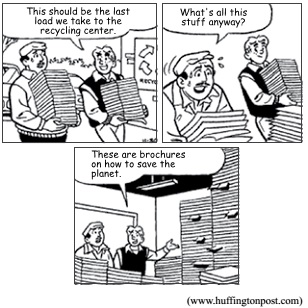
No trecho do primeiro quadrinho – This should be the last load –, a palavra should indica uma ideia de

A
dúvida.
B
solicitação.
C
obrigação.
D
recomendação.
E
expectativa.
82451844-9f
UNESP 2013 - Inglês - Sinônimos | Synonyms, Advérbios e conjunções | Adverbs and conjunctions

No trecho final do último parágrafo – “all-natural” does not mean the product qualifies as Certified Organic, so be sure to look beyond the hype. –, a conjunção so pode ser substituída, sem alteração de sentido, por

How can consumers find out if a corporation is “greenwashing” environmentally unsavory practices?

imagem-008.jpg
A
however.
B
furthermore.
C
because.
D
although
E
therefore.