The proverb which can best summarize the main idea present in the song is:


You missed the starting gun (ℓ. 12)
The fragment above ends the metaphor created in the second stanza.
This metaphor establishes a connection between “life” and the following element:

Plans that either come to naught (ℓ. 19)
Or half a page of scribbled lines (ℓ. 20)
The underlined expressions associate the plans mentioned by the poet to the following idea:

The song “Time” could be used to introduce the class “O tempo em nossas vidas” suggested in the text “Física para poetas”.
The fragment of the lyrics that best relates to the class is:

the question is not if another outbreak will happen, but when, (l. 28-29)
The underlined words present the health community’s opinion concerning new outbreaks of epidemics.
According to their opinion, future outbreaks are seen as:

The texts “Três teses sobre o avanço da febre amarela” and “The effect of climate change on epidemic risk” mention possible reasons for disease outbreaks.
The reason which is presented in both texts is:

Current evidence suggests that these differences are not simply the result of recent acclimation (l. 19-20)
The underlined word above indicates that the author is cautious when he states that fact.
The sentence from the text that shows the same attitude on the author’s part is:

factors yet to be found. (l. 31)
The expression yet to be found is used to represent an action which:

Human populations differ in various phenotypes (l. 5)
In relation to these phenotypes, scientists have reached the following conclusion:

The text “Lucy caiu da árvore” is about an ancestral African female. Her characteristics can be related to the studies on phenotypes presented in the text “Recent human adaptations”.
Among her characteristics, the ones that best illustrate one of these studies are:

Writers use different strategies in order to try to form more effective alliances with readers.
The resource used in the last paragraph to establish this alliance is in the use of:

The author criticizes the first vision of negotiation of difference in society.
This criticism is related to ideologies having the following characteristic:

In the last two paragraphs, the author establishes a relationship between the ideas of self-worth and one’s looks.
This relationship is best expressed in:

But I’ve been there, done that. (l. 14)
The underlined expression refers to the author’s experiencing the situation described below:

the exact number on the scale I was at that particular time in my life. (l. 5-6)
Concerning the author’s feelings, the statement above illustrates the following fact:

The texts “O poder criativo da imperfeição” and “Our (im)perfect bodies” discuss the concept of perfection, using examples from their respective areas.
The sentence that best represents the idea discussed in both texts is:


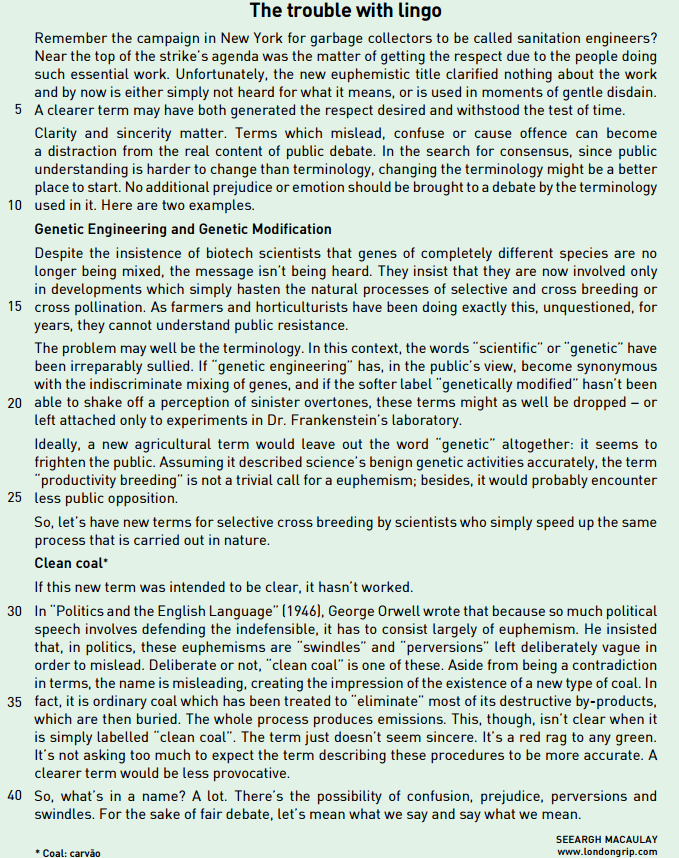
According to the text, the use of the expression “clean coal” might infuriate ecologists.
This idea is explicit in:

these euphemisms are “swindles” and “perversions” (l. 32)
The term just doesn’t seem sincere. (l. 37)
It’s a red rag to any green. (l. 37)
A clearer term would be less provocative. (l. 38-39)