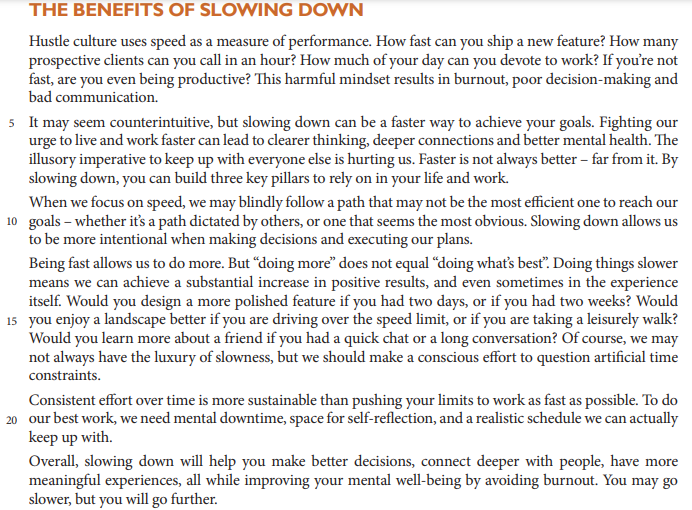
Helpful methods to slow down include journaling, (l. 25-26)
The underlined word may be substituted, without significant change in meaning, by the words
below:



to acknowledge what is working in our communities and in our movements. (l. 31)
The underlined word may be substituted, without significant change in meaning, by the one below:
Essential reading on, and beyond, Indigenous Peoples Day

our people are still being attacked by the many forms of colonization, (l. 29-30)
The sentence above exhibits the passive voice.
Another occurrence of the passive voice is underlined below:
Essential reading on, and beyond, Indigenous Peoples Day


PAUL SIMON and ART GARFUNKEL
Adaptado de genius.com.

PAUL SIMON and ART GARFUNKEL
Adaptado de genius.com.
the needy
the elderly
the hippies
the workers

PAUL SIMON and ART GARFUNKEL
Adaptado de genius.com.

PAUL SIMON and ART GARFUNKEL
Adaptado de genius.com.

PAUL SIMON and ART GARFUNKEL
Adaptado de genius.com.

PAUL SIMON and ART GARFUNKEL
Adaptado de genius.com.
Morro velho

MILTON NASCIMENTO
Adaptado de miltonnascimento.com.br.

PAUL SIMON and ART GARFUNKEL
Adaptado de genius.com.
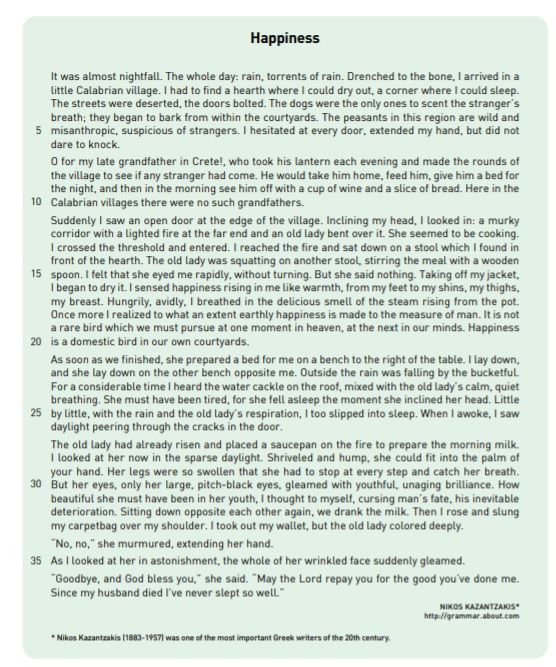
The old lady is presented by means of the description of her actions and looks.
The passage from the text which best describes her bodily appearance is in:

In the third and fourth paragraphs, there are different sensory images, as in the fragment below:
I breathed in the delicious smell of the steam rising from the pot. (l. 17 )
In this fragment, the narrator makes use of the following type of imagery:
Happiness is a domestic bird in our own courtyards. (l. 19-20)
This fragment contains a figure of speech which is labeled as:
According to some authors, a memoir is how one remembers one’s own life; an autobiography is history, requiring research, dates and facts.
In relation to the author’s life, the text Happiness can be characterized as a memoir especially
because of the presence of:
The first paragraph describes the terrible weather, the physical state of the narrator and his unfavorable view of the village and its inhabitants.
From this beginning, one can infer that the narrator did not expect the peasants to:
In the second paragraph, Kazantzakis introduces a flashback, an interruption in the telling of the major action to show an episode that happened at an earlier time.
In this narrative, the flashback has the function of:
In his posting, Po Bronson asks forum participants for help.
This help consists of:

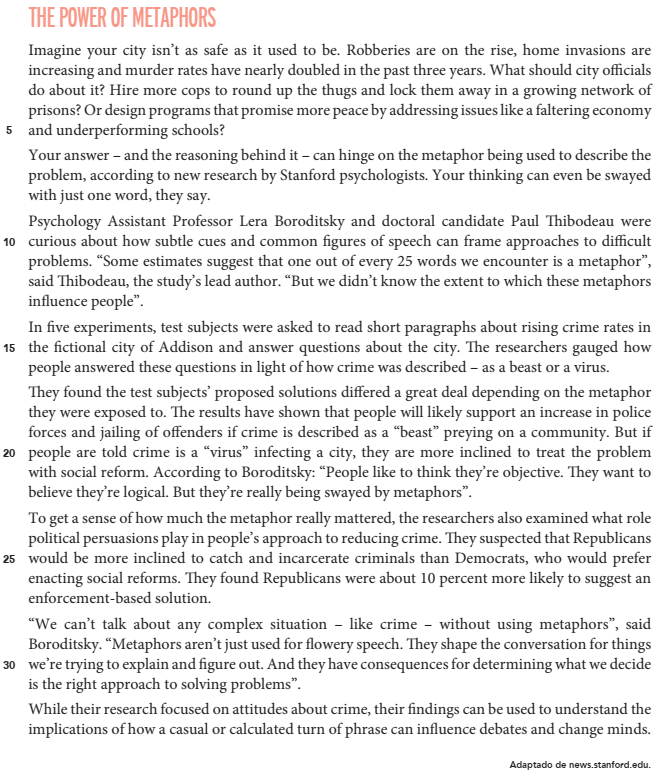
we didn’t know the extent to which these metaphors influence people. (ℓ. 12-13)
In the fragment above, the doubt expressed by the researcher can be formulated by the following question: